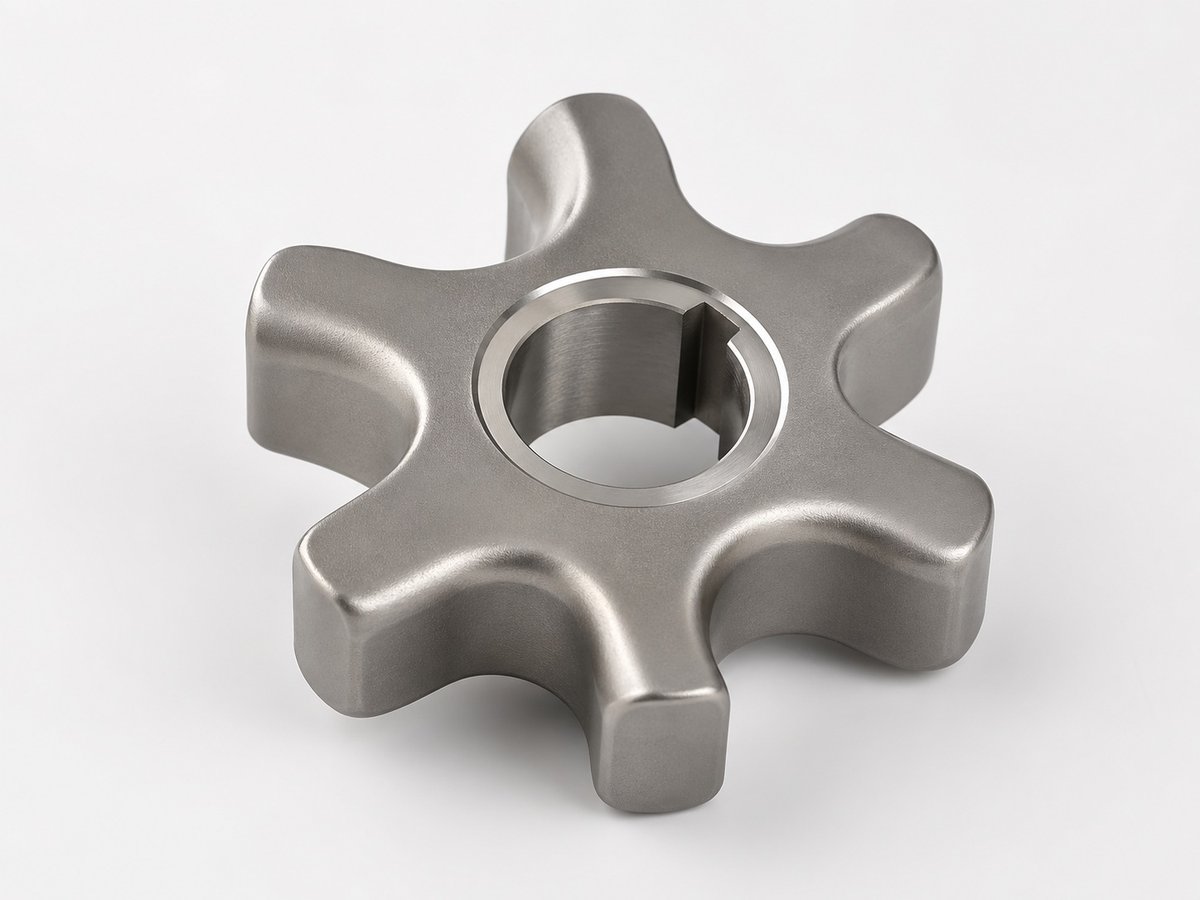
Star rotor 6-vane. Total cost reduced by 18 percent — with no change in function.
Real customer project, published in anonymised form — see Method for the origin of the figures.
Why the part became a project.
A German hydraulics OEM had produced the star rotor for more than a decade at a domestic MIM supplier. The function was flawless, as was delivery performance — but the purchase price had risen incrementally by 27 percent since 2019.
Internal machining or process changes were not possible: the star rotor is part of an approved hydraulic valve with a 15-year type approval. Any change to the material or the base process would have triggered a re-approval.
Our task: identical geometry, identical material, identical process chain — but a different network site with a better cost structure. This is the classic "same spec, different site" application case.
How the source was selected.
Three plants were approached and two released together: a primary plant in the Czech Republic and a secondary plant in Poland. Material, geometry and process chain stayed unchanged — only the site moved.
Assessment follows the standardised decision matrix — unit price, series lead time, free capacity, quality index, audit status, risk class and CO₂ per part, each weighted. We do not publish the individual plant ratings. They contain capacity and quality data on our manufacturing partners and would allow conclusions about the customer’s sourcing decision. You receive your own matrix with the quotation — confidential, as agreed in the NDA.
From brief to series. Documented.
Every step was recorded — customer, MIM Experts and the two network plants always shared the same level of information. The timeline covers tooling, sampling with shrinkage correction, PPAP and the customer’s approval loops. Tooling is by far the longest single item — it determines when an MIM series can start.
What changed for the customer.
Once material and geometry are frozen by a type approval, the production site is the only cost lever left. — Assessment · MIM.Experts Engineering
The component, material, weight, annual volume and project trigger come from a completed customer project, published with the customer’s consent. We do not name the customer, the part number or the prices. The commercial figures in this example — savings, cost shares, the price relationship between sites — are recalculated and not taken from the project file. Model: feedstock cost by material, geometry-based cycle time via the number of cavities, sintering share by component weight, post-processing and inspection by requirement profile. Machine hourly rate €85/h, yield 92 %, overhead and margin 35 %.
Site assessment, Q-score and free capacity are component- and date-specific and are re-established for every enquiry — the same plant may be rated differently in two projects. Only a quotation issued after component analysis is binding. To the price calculator